


Step 20: Run an experiment with Shells
When Shells runs, it must connect to a number of input files (already
existing) and output files (new filenames; to be created), as detailed in the
table below.
The color-code in this table is that:
Orange identifies input files that are required in all cases, while
Yellow identifies input files that may be required in certain cases, and
Green indicates new output files that will (or may) be created.
|
Fortran device number (channel) |
Type of input/output file to connect: |
Sample file of this type: (most are located in folder /oldFTP/neotec/Shells/ Earth5/Earth5-049/ ) |
|
1 |
finite element grid (.feg) file [input] |
|
|
2 |
boundary conditions (.bcs) file |
|
|
3 |
parameter input (.in) file [input] |
|
|
8 |
digitized plate outlines [input] |
|
|
9 |
digitized plate boundaries, with identification of the polarity of any subduction zones [input] |
|
|
11 |
approximate velocity solution (v_____.out) file (used for restarting iteration) [optional input] |
|
|
12 |
special file describing lower-mantle flow; only required if parameter |
PB2002_plates.dig (if
|
|
13 |
old torque- and force-balance report for each plate, produced by a previous run of Shells [potential input] |
qEarth5-049.out
[needed if |
|
14 |
flat-file ASCII table of additional Lithospheric Rheologies (in addition to default rheology LR0), to match any LR#s > 0 that may appear in your .feg grid file [potential input] |
[This feature is new with Shells_v5.0, and was not used in the Earth5-049 model.] |
|
21 |
text output (t_____.out) file [output] |
|
|
22 |
nodal velocity (v_____.out) file [output] |
|
|
23 |
reaction force (f_____.out) file [output] |
|
|
24 |
new torque- and force-balance report for each plate, produced by this run of Shells [output] |
|
|
25 |
temporary file "iteration permit.txt" which can be deleted (mid-run) by the user in order to interrupt a long set of iterations without crashing Shells [output, then input] |
[not shown] |
There are (at least) two different ways of connecting these input and output files:
1. Interactive, real-time prompting method:
When Shells begins to run it will start by
asking a question in the console window:
Enter a file name for the
(new) output log file:
and you can answer with any new file-name you like (probably ending in _log.txt).
A moment later, it will prompt you again with:
Attempting to read finite
element grid from unit 1
File name missing or blank - please enter file name
UNIT 1?
and this time you need to supply the name of an existing .feg
file (available in the active folder),
such as Earth5R.feg
in the example given above.
In this way, you can gradually specify the names of
all the input and output files outlined by the table above.
However, there may be as many as 13 of these files, and this method is subject
to error, and becomes tedious.
2. Collect your responses into an ASCII text file:
For repeated runs of Shells (particularly
when you are only varying one parameter each time) you will probably want to
automate your responses.
Use any simple ASCII text editor (such as NotePad, or EditPad Pro)
to build (or modify) a list of your responses to all the prompts, such as (for
example):
Earth5-049_log.txt
<= (NEW output text
file from this run, Fortran unit 21)
Earth5R.feg
<= (existing
.feg grid file, Fortran unit 1)
iEarth5-049.in
<= (existing parameter
file, Fortran unit 3)
PB2002_plates.dig
<= (existing .dig file
of plate-outlines, Fortran unit 8)
qEarth5-049.out
<= (existing
torque-report file from a previous iteration of the Shells model, when iConve =
6, Fortran unit 13)
X
<= (name
of a NON-existent input file, instead of using an old vSomething.out file to
initialize, Fortran unit 11)
Earth5R-type4AplusA.bcs <= (existing input .bcs file with boundary
conditions, Fortran unit 2)
PB2002_boundaries.dig <= (existing .dig file of
plate-boundaries, Fortran unit 9)
vEarth5-049.out
<= (NEW output file with nodal velocities from this model, Fortran unit 22)
fEarth5-049.out
<= (NEW output file with nodal forces from this model, Fortran unit 23)
qEarth5-049.out
<= (NEW output file with torque-report from this model, Fortran unit 24)
<= (include one extra CR/LF {using your “Enter” key} at the end of your file
Note that you should NOT type the comments like “<= (NEW …” into your file, or it won’t be read properly!
Save this file with a name specific to the particular Shells model, such as: Earth5-049_filenames.txt.
Then, you go the Windows command prompt, and enter:
Shells_v5.0-Win64par.exe
< Earth5-049_filenames.txt
and the whole model should run without requiring any more input.
(Of course, substitute “32”
for “64” if you
have a 32-bit Windows computer, and substitute “seq” for “par”
to run the sequential-execution version.)
You may wish to save this ___filenames.txt file (along with the output files, and extra copies of any input files that were modified to include variable parameter values) in a new folder, named to describe that particular run of Shells. That will provide a record of exactly what job was run.
Shells should provide a table called "Iteration History" as part of its text output in the new _____log.txt file (Fortran device 21), and it should look something like this:
ITERATION HISTORY: RELATIVE CORRE- MAXIMUM MEAN RELATIVE LATION VERTICALLY VERTICALLY MAXIMUM MEAN WITH INTEGRATED INTEGRATED ITER- RMS VELOCITY VELOCITY LAST STRESS STRESS ATION VELOCITY CHANGE CHANGE CHANGE ERR0R ERR0R 1 6.671025E-11 1.4950E-10 1.000000 ---- 1.7092E+16 .993490 2 6.304374E-11 4.0193E-11 .137291 -.63 3.6075E+13 .378274 3 6.171746E-11 1.8318E-11 .066566 .76 4.7169E+13 .346676 4 6.110019E-11 9.6699E-12 .054420 .94 4.3406E+13 .339420 5 6.097313E-11 6.9601E-12 .042287 .99 3.5744E+13 .321039 6 6.104579E-11 4.8806E-12 .030164 .99 3.5259E+13 .288665 7 6.111884E-11 3.6560E-12 .021870 .99 3.2814E+13 .249889 8 6.116438E-11 2.7920E-12 .016233 1.00 3.4038E+13 .210514 9 6.120358E-11 2.2050E-12 .012962 1.00 1.8886E+13 .177277 10 6.123600E-11 1.7543E-12 .010455 1.00 2.0459E+13 .151851 11 6.124162E-11 1.3929E-12 .008227 1.00 2.8621E+13 .129272 12 6.124802E-11 1.2190E-12 .006900 1.00 2.5601E+13 .111101 13 6.124833E-11 1.1118E-12 .005794 1.00 1.8946E+13 .097004 14 6.123912E-11 1.0577E-12 .005094 1.00 1.2855E+13 .085483 15 6.123926E-11 9.6767E-13 .004568 1.00 1.0113E+13 .074999 16 6.123978E-11 8.6750E-13 .003997 1.00 8.9478E+12 .064639 17 6.124278E-11 7.5090E-13 .003491 1.00 9.2755E+12 .057505 18 6.125361E-11 6.4242E-13 .003049 1.00 7.3854E+12 .050013 19 6.127198E-11 5.5315E-13 .002617 1.00 6.6525E+12 .044480 20 6.129393E-11 4.7318E-13 .002212 1.00 5.3433E+12 .039265 21 6.131728E-11 4.0393E-13 .001880 1.00 6.8598E+12 .034951 22 6.134085E-11 3.4605E-13 .001606 1.00 8.2828E+12 .031143 23 6.136439E-11 2.9741E-13 .001391 1.00 7.3014E+12 .027845 24 6.138654E-11 2.5652E-13 .001205 1.00 6.0201E+12 .025084 25 6.140663E-11 2.2168E-13 .001046 1.00 5.5352E+12 .022969 26 6.142430E-11 1.9390E-13 .000916 1.00 5.1053E+12 .021258 27 6.143915E-11 1.7637E-13 .000805 1.00 4.6690E+12 .019945 28 6.145105E-11 1.8290E-13 .000706 1.00 4.1747E+12 .018810 29 6.146025E-11 1.9527E-13 .000624 1.00 4.8535E+12 .017693 30 6.146818E-11 2.0409E-13 .000568 1.00 6.0509E+12 .016545 31 6.147545E-11 2.0975E-13 .000523 1.00 4.0108E+12 .014991 32 6.148303E-11 2.1244E-13 .000495 1.00 3.9696E+12 .013836 33 6.149065E-11 2.1109E-13 .000467 1.00 3.8282E+12 .012943 34 6.149793E-11 2.0582E-13 .000437 1.00 3.6485E+12 .012218 35 6.150450E-11 1.9935E-13 .000399 1.00 4.1463E+12 .011425 36 6.151064E-11 1.9136E-13 .000369 1.00 4.7319E+12 .010748 37 6.151652E-11 1.8137E-13 .000342 1.00 3.3119E+12 .009961 38 6.152232E-11 1.7012E-13 .000318 1.00 3.9367E+12 .009267 39 6.152796E-11 1.5838E-13 .000295 1.00 3.9631E+12 .008742 40 6.153339E-11 1.4642E-13 .000274 1.00 1.9996E+12 .008194 41 6.153864E-11 1.3427E-13 .000257 1.00 1.8821E+12 .007794 42 6.154367E-11 1.2248E-13 .000242 1.00 1.8185E+12 .007416 43 6.154861E-11 1.1111E-13 .000229 1.00 1.9659E+12 .007063 44 6.155340E-11 1.0026E-13 .000218 1.00 1.7831E+12 .006717 45 6.155805E-11 9.0069E-14 .000207 1.00 1.5092E+12 .006341 46 6.156260E-11 8.0702E-14 .000197 1.00 1.4318E+12 .006023 47 6.156717E-11 7.2161E-14 .000189 1.00 1.3508E+12 .005732 48 6.157177E-11 6.4406E-14 .000180 1.00 1.3697E+12 .005473 49 6.157626E-11 5.7332E-14 .000173 1.00 1.6307E+12 .005227 50 6.158074E-11 5.0900E-14 .000165 1.00 ITERATION LIMIT REACHED BEFORE CONVERGENCE. ---------------------------------------------------------------------- |
All units are SI, so the "RMS velocity" and "Maximum velocity change" are in m/s (typically a very small number), and the "Maximum vertically-integrated stress error" is in Pa m, or N/m (a very large number).
If we graph the two dimensionless measures of this table using a logarithmic scale, we should see steady progress:
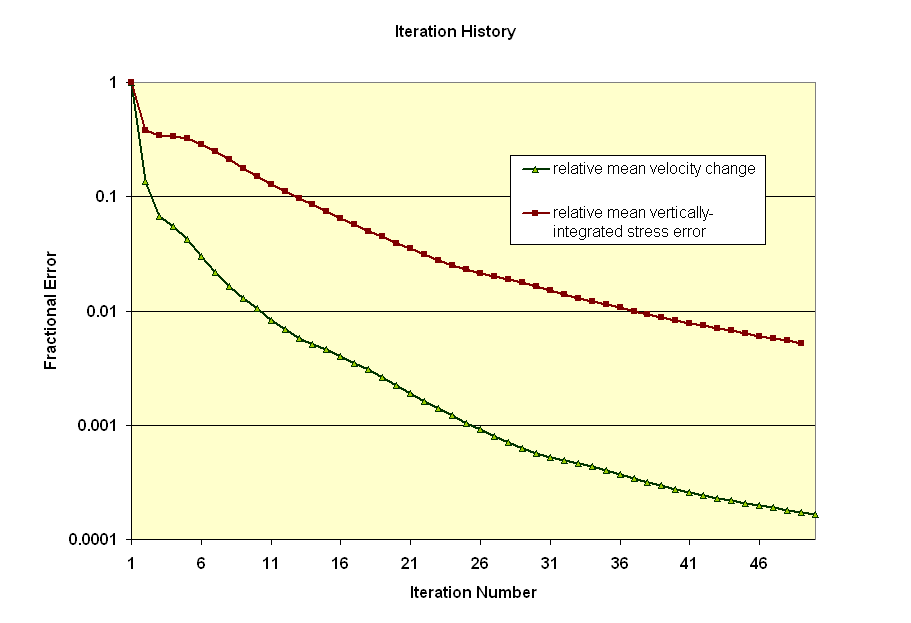
If you do not get steady convergence, the most likely causes are:
 The
solution to the problem you have posed includes one or more
"landslides" (localized flows down a topographic gradient) with very
high steady-state velocities. The symptom of this is that the RMS velocity
(column 2 in the table above) increases in each iteration, in a pattern of
quasi-exponential growth. The solution to such cases is to plot the velocity
solution (even though it is not converged) to see where the landslide(s)
is/are. Then, you can strengthen the lithosphere either locally (by moderating
the heat-flow or topography) or globally (by changing rheologic constants).
The
solution to the problem you have posed includes one or more
"landslides" (localized flows down a topographic gradient) with very
high steady-state velocities. The symptom of this is that the RMS velocity
(column 2 in the table above) increases in each iteration, in a pattern of
quasi-exponential growth. The solution to such cases is to plot the velocity
solution (even though it is not converged) to see where the landslide(s)
is/are. Then, you can strengthen the lithosphere either locally (by moderating
the heat-flow or topography) or globally (by changing rheologic constants).
If
there is steady convergence at first, and then a transition to a limiting
"noise level" of velocity change and/or stress error, then actually
this is normal. (It is just that we usually stop the program before this level
is reached.) The "noise level" is largely determined by input
parameter OKDelV, which is a
velocity (in m/s) precision that we hope to reach, but may not. If this
parameter is too large, then convergence will be rapid, but the solution will
not be accurate. (This is because the maximum limit on viscosity will be set
rather low, and thus the viscosity limit rather than the desired flow law will
determine the strain rate at many points.) However, if this parameter is made
very small, later iterations may be "wasted" in the sense that the
computer runs on but the solution no longer improves.